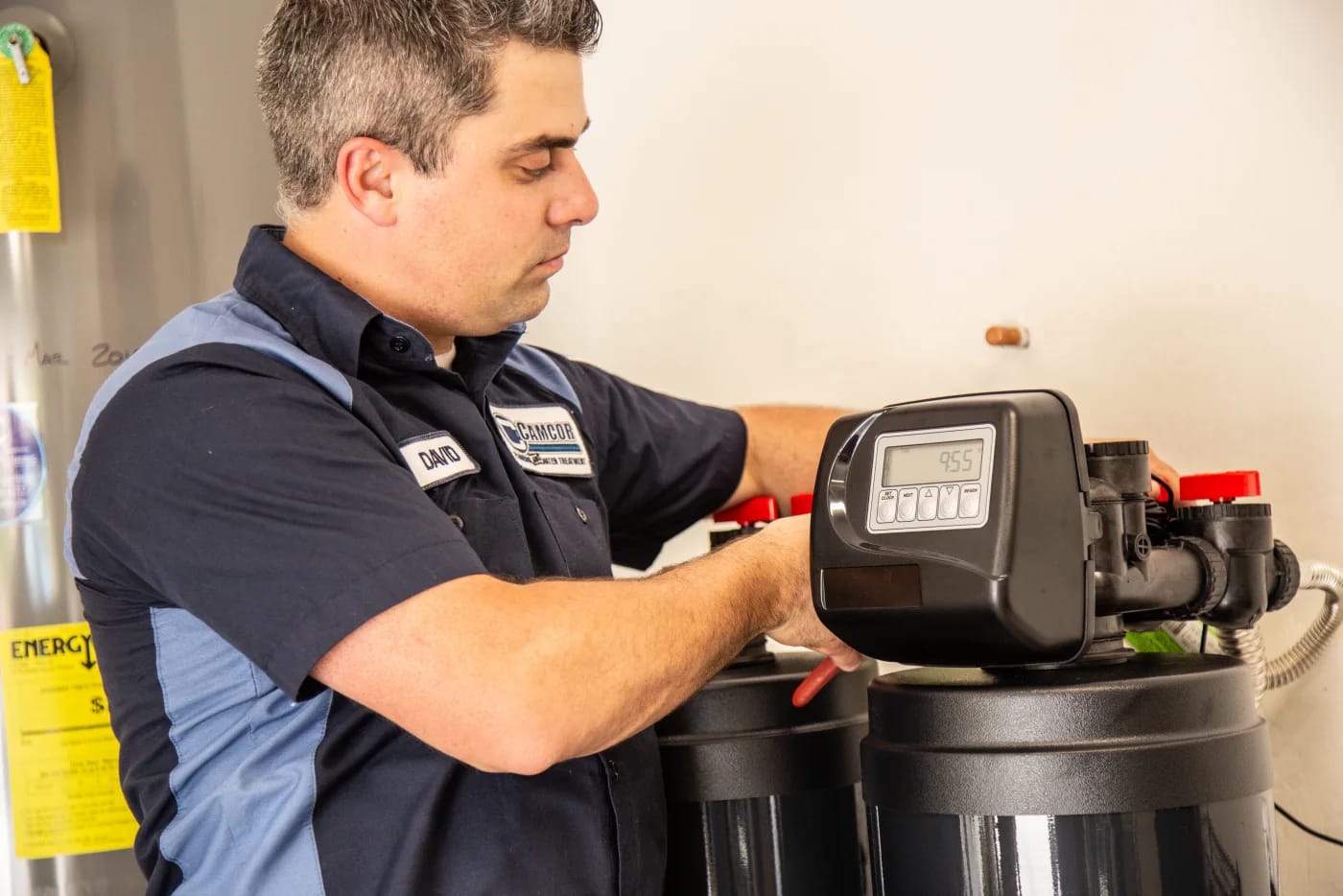
Know what is actually in your water before anyone sells you a system
Water Quality Testing in Mesa, AZ
Camcor Plumbing tests water quality in Mesa, Las Sendas, Gilbert, Chandler and across the East Valley. Hardness, TDS, chlorine and pressure — measured at your tap, written down, and explained without a sales script attached.
Know What Is In Your Water
East Valley municipal water is safe to drink. It is also some of the hardest water in the country — routinely 15 to 25+ grains per gallon, which is roughly three to five times the level at which the water treatment industry considers water "hard." That hardness is why water heaters in Mesa fail years early, why fixtures spot no matter how you clean them, why laundry comes out dingy, and why an RO membrane installed without pretreatment will not last its rated life.
But "hard water" is a range, not a fact. Hardness varies by which source is feeding your area, by season, and by how far you sit from the treatment plant. A home in Las Sendas and a home in west Mesa are not necessarily on the same number. Sizing a softener off a regional average instead of your actual reading is how homeowners end up with a unit that regenerates too often, wastes salt, or runs out of capacity halfway through a Sunday.
A water quality check takes about twenty minutes. We test hardness in grains per gallon, take a total dissolved solids reading, check for chlorine and chloramine, and measure your incoming pressure — because pressure affects everything downstream, including whether an RO system will produce properly. If you already have a softener or an RO, we test whether it is actually working, which is frequently the real answer when someone calls us convinced they need a new one.
Then we tell you what the numbers mean. Sometimes that means a properly sized softener is the highest-value plumbing investment you can make. Sometimes it means your existing system needs a $180 repair rather than a $4,000 replacement. And sometimes it means your water is fine for what you are asking of it and you should keep your money. We are a repair-first company — that applies to water treatment exactly the same way it applies to a water heater.
What We Test For
Our expert contractors specialize in all types of water quality testing projects.
Hardness (Grains Per Gallon)
The number that drives everything else. Hardness determines softener sizing, water heater lifespan and scale rate throughout the home.
- Grains-per-gallon reading
- Softener sizing calculation
- Scale risk assessment
- Water heater impact
- Appliance lifespan estimate
Total Dissolved Solids (TDS)
TDS is the taste and mineral-load measure. It is the primary indicator of whether reverse osmosis will meaningfully improve your drinking water.
- TDS meter reading
- RO benefit assessment
- Taste and odor context
- Post-RO verification
- Membrane performance check
Chlorine & Chloramine
Municipal disinfection byproducts drive the smell at the shower and the dryness people blame on the desert. Carbon filtration is the fix when it is a real problem.
- Chlorine level check
- Chloramine screening
- Shower and skin context
- Carbon filtration sizing
- Whole-home vs point-of-use advice
Water Pressure
Pressure affects fixture life, RO production and whether a filtration system will create a noticeable drop. High pressure quietly destroys plumbing.
- Static pressure reading
- PRV condition check
- RO production feasibility
- Filter sizing for pressure
- Over-pressure risk flag
Existing System Performance
Testing before and after your current softener, filter or RO tells us whether it is working, degraded, bypassed or failed outright.
- Pre and post treatment test
- Resin condition assessment
- Bypass valve check
- Filter and membrane age
- Repair vs replace answer
Well Water Screening
Homes on private wells outside city service have a different problem set — iron, sulfur, sediment and bacteria risk rather than municipal hardness alone.
- Iron and sulfur indicators
- Sediment load check
- Lab test coordination
- Well pump pressure context
- Treatment train recommendation
How a Water Quality Check Works
Schedule the Visit
Call or request online. We work around your schedule — the test itself takes about twenty minutes at the kitchen tap.
Test at the Source
Hardness, TDS, chlorine and incoming pressure, measured from your own plumbing rather than a neighborhood estimate.
Check Existing Equipment
If you already have a softener, filter or RO, we verify it is actually doing its job — before anyone discusses replacing it.
Walk Through the Results
We write the numbers down and explain what each one means for your water heater, your fixtures and your drinking water.
Honest Recommendation
Treat it, repair what you have, or leave it alone. Whichever one the numbers support — with a written quote if you want one.
Safety First
- • OSHA-compliant safety procedures
- • Licensed and insured team
- • Proper protective equipment
- • Dust control systems
- • Structural integrity protection
Eco-Friendly Disposal
- • Material recycling programs
- • Donation of reusable items
- • Responsible waste disposal
- • Environmental compliance
- • Minimal landfill impact
FAQ — Vol. 04
Water Quality Testing FAQ
What East Valley homeowners ask before scheduling a water check
An in-home hardness, TDS, chlorine and pressure check is free when we are out for it or already on site for other work. There is no obligation attached and no requirement to buy anything.
Typically 15 to 25+ grains per gallon, which is very hard by any standard. The exact number varies by source and by area, which is the entire reason we test at your tap rather than quoting a regional average.
Yes. Mesa municipal water meets all federal and state safety standards. Testing is about hardness, taste, scale and equipment protection — not about safety scares. Anyone selling you a system on a safety scare is selling, not testing.
No. We are a plumbing company that does water treatment, not a water treatment sales company. If your numbers do not justify a system, we tell you that and leave.
Yes, and this is one of the most useful things we do. We test before and after the unit. If it is passing hard water through, we find out why — resin exhaustion, a stuck bypass, a failed valve or a control head problem. Many of those are repairs, not replacements.
About twenty minutes for a standard in-home check, including walking you through what the readings mean. Testing an existing system adds a few minutes.
We screen well water for the common Arizona issues — iron, sulfur, sediment and hardness — and coordinate certified lab testing when a full potability panel is warranted.
Whatever you want. We write the numbers down and leave them with you. Plenty of homeowners take the reading, think about it for a year and call us later. That is fine — the numbers do not expire quickly.
Related services
Other plumbing services we handle.
Camcor Plumbing is a full-service residential plumber — water heaters, drains, water treatment, fixtures and more, all done with the same repair-first approach.
Water Quality Testing — coverage
Water Quality Testing in cities across the metro.
Water Quality Testing is available in every city we serve across the East Valley and Phoenix Metro.
Ready when you are
READY FOR YOUR WATER QUALITY TESTING?.
Get a free estimate for your water quality testing project. Fast, safe, and professional service guaranteed.